



What Changed Since Last Year? The Question That Should Open Every Budget Workshop

Association Management Team • October 1, 2026

Share this article

Most budget workshops start with last year's spreadsheet. Starting with what changed instead gives your board a budget it can actually explain.


Most condominium budget workshops start the same way.


Someone opens last year's spreadsheet. The board reviews the numbers, adjusts a few line items, discusses what appears to be increasing, and eventually arrives at the total.


But before getting into the numbers, there is a more useful question to ask:


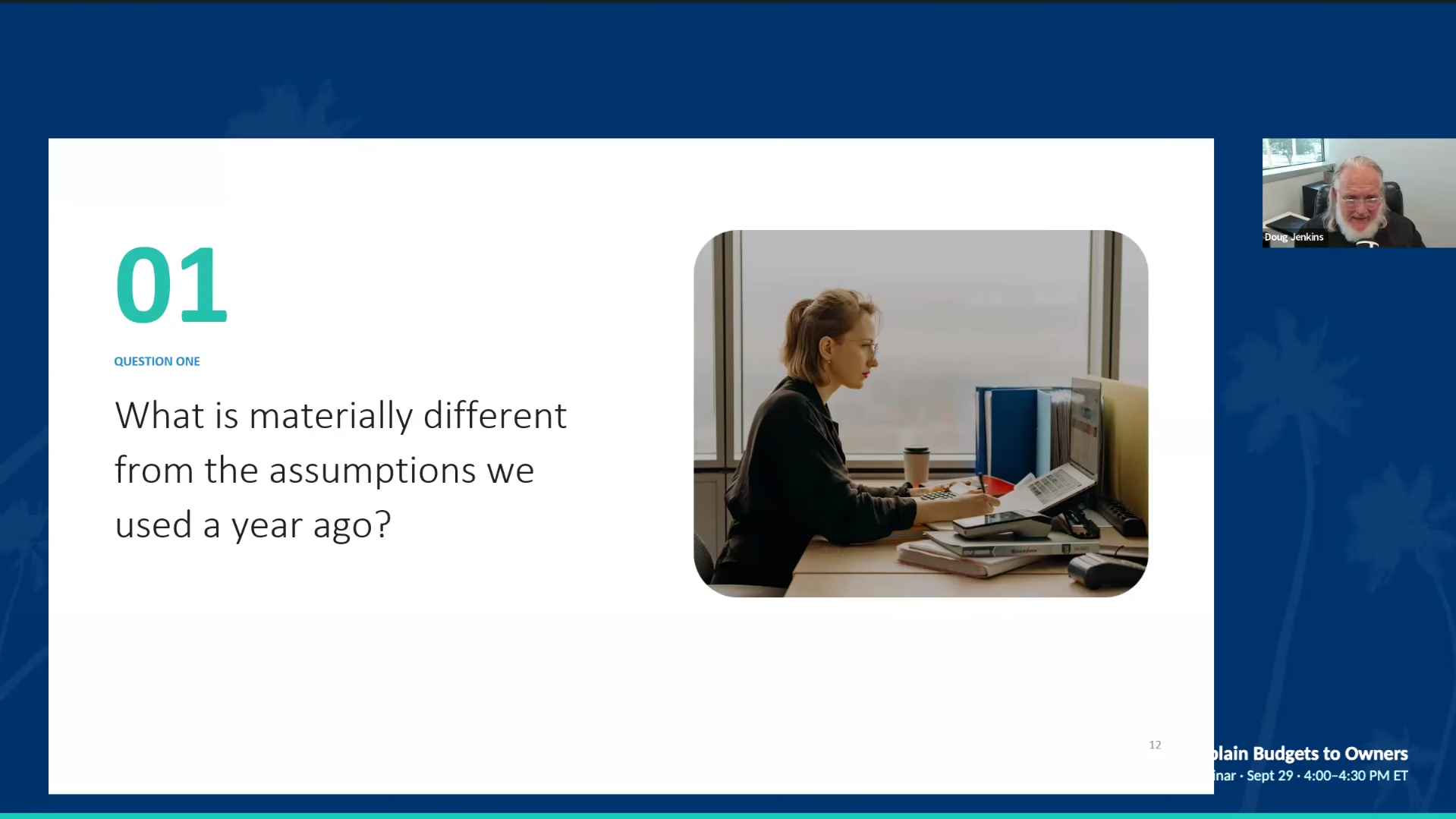
What is materially different from the assumptions we used a year ago?


Doug Jenkins of Association Training Hub puts this question at the beginning of his budget discussion for a reason. A budget is built on assumptions about what the association expects to spend, what services will cost, what projects will be needed, and what financial conditions may look like over the coming year.


Some of those assumptions will still be accurate.


Some will not.


Before simply adjusting last year's numbers, the board should understand which assumptions have changed and what those changes mean for the association.

A Budget Is Built on Assumptions

Last year's budget represented what the board knew and expected at the time.


Insurance was expected to cost a certain amount. Utility expenses were based on previous rates and usage. Vendor contracts had known pricing. Reserve funding and capital projects were based on the information available to the board.


A year later, the circumstances may be different.


An insurance renewal may have come in higher than expected. A vendor may have increased its contract price. Utility rates may have changed. A building inspection may have identified a repair that was not previously anticipated. A reserve study may have changed the timing or estimated cost of a major project.


That is why starting with "What changed?" can be more useful than starting with "What percentage should we increase last year's budget?"


The first approach examines the assumptions.


The second simply adjusts the numbers.

What Does "Materially Different" Actually Mean?

Not every change deserves the same amount of board attention.


A small increase in office supplies is unlikely to affect the association's overall financial position. A significant change in insurance, utilities, or a major capital project could.


The question is intended to identify the changes that can actually move the budget or affect what the association is able to accomplish during the year.


For many condominium associations, the areas worth reviewing closely may include:


  • Insurance: Has the renewal premium changed? Are the coverage terms or deductibles different?
  • Utilities: Have water, sewer, electricity, or other utility rates changed?
  • Contracted services: Are existing vendor contracts being renewed at a higher cost?
  • Building inspections and maintenance: Have inspections identified new repairs or maintenance requirements?
  • Reserve projects: Has a reserve study or updated project information changed the expected timing or cost of a major replacement?
  • Labor and service costs: Have vendors changed their pricing or the scope of services?


The exact list will be different for every association.


The goal is to find the handful of assumptions that could have a meaningful impact on the budget.

Ask the Question Line by Line

Saying "costs went up" does not give a board enough information to make a meaningful decision.


A better discussion asks:


  • What changed?


  • Why did it change?


  • How much will it affect the budget?


  • What information supports the new assumption?


For example, instead of simply saying that utility expenses increased, the board should be able to identify whether the change came from increased rates, increased usage, a change in service, or another factor.


That distinction matters when the budget eventually reaches the owners.


One explanation invites more questions about whether the board is simply spending more.


The other gives owners context for why the number changed.


When managers and treasurers can explain each material change, the budget becomes less about debating a total and more about understanding the decisions behind it.

Focus on the Numbers That Actually Matter

Budget workshops can become unnecessarily long when every line item receives the same amount of attention.


They do not all have the same impact.


Instead, consider identifying the major changes before the workshop and bringing those items to the front of the discussion.


A simple worksheet can help:

Budget Area Previous Assumption What Changed? Budget Impact
Insurance Prior-year estimate New renewal pricing $XX,XXX
Utilities Prior-year rates/usage Rate or usage change $XX,XXX
Vendor Contracts Existing contract Renewal increase $XX,XXX
Capital Projects Existing project schedule Updated timing/cost $XX,XXX
Reserves Previous funding plan Updated project needs $XX,XXX

The purpose is not to create another complicated budgeting process.


It is to make the important changes easier for the board to see and discuss.

Don't Just Identify the Change. Document It.

Once the board identifies a material change, document the reasoning behind it.


That information can be included in the budget packet, meeting materials, minutes, or a short supporting memo.


For example:


Insurance was budgeted based on the agent's preliminary renewal indication. Final renewal information was expected later in the year.


That simple note can be valuable later.


Future board members can see what information was available when the budget was developed. Owners who have questions can understand the basis for a major assumption. Managers can refer back to the reasoning when preparing the following year's budget.


The documentation also creates a clearer record of how the board approached its financial decisions.


A board that identifies a significant change, reviews the available information, documents its assumptions, and makes its decision with that information in front of it has created a much clearer record than a board that simply carries a number forward from the previous year.

The Budget Should Tell a Story

A good budget is more than a collection of numbers.


It tells the story of what the association expects to spend, why those expenses are changing, and what the board is planning for the year ahead.


That story becomes especially important when owners ask questions about assessments. It matters just as much to the board that adopts it, which is not always the board that drafted it.


If insurance increased, the board should be able to explain that.


If a major capital project needs to be funded, the board should be able to explain that.


If a contract was renewed at a different rate, the board should be able to explain that.


Owners do not necessarily need every detail behind every line item. But the board should understand the significant assumptions well enough to explain them clearly.


That starts with understanding what changed.

A Simple Exercise for Your Next Budget Workshop

Before opening last year's spreadsheet, take a few minutes to answer one question:


What is materially different from the assumptions we used a year ago?


Then work through the major categories.


For each significant change, identify:


  1. What changed?
  2. Why did it change?
  3. What information supports the change?
  4. What is the financial impact?
  5. Does the change affect any other part of the budget?


Once those questions have been answered, the board can move into the actual numbers with a much clearer understanding of what needs attention.

Watch the Full Webinar With Doug Jenkins

This question comes from Doug Jenkins of Association Training Hub's discussion on helping Florida condominium and HOA boards approach budget conversations with greater context and judgment.


The full session covers five questions boards can use when reviewing and explaining their budgets.

If your board is preparing for its next budget cycle, consider starting with Question #1:


What is materially different from the assumptions we used a year ago?


It may be the simplest question in the workshop, but it can help the board focus its time on the changes that actually matter.

Need Help Preparing for Your Next Budget?

Budget planning is an important part of helping a condominium association operate with greater clarity and confidence.


The Condominium Associates team works with boards throughout Florida to help them navigate the financial, operational, and management decisions that come with running a community.


If your board is preparing for its next budget cycle and wants help working through the assumptions behind the numbers, reach out to Condominium Associates.

Recent Posts

Stressed person buried in paperwork with an alarm clock on their head in an office
By Association Management Team • September 22, 2026
A deadline-focused article for condo boards approaching the end of 2026. Rather than explaining SIRS generally, this article provides a final compliance and planning checkpoint.

Four coworkers lean over a table, discussing colorful papers and markers in an office.
By Association Management Team • September 22, 2026
Completing a Structural Integrity Reserve Study is only the beginning. The real challenge for a condo board is translating the engineer's findings into funding decisions, project timelines, owner communication, and long-term maintenance planning.

Woman on a couch looking surprised at a laptop in a bright living room
By Association Management Team • August 31, 2026
As of January 1, 2026, Florida condo associations with 25 or more units must post official records online. Here's exactly what belongs on your website and when.

Judge with white wig reading a document at a desk with a gavel in the foreground
By Association Management Team • August 24, 2026
A plain-English breakdown of Florida's HB 913 and what condo association boards must do to stay compliant in 2025 and beyond.

By Association Management Team • August 17, 2026
D&O insurance protects volunteer board members from personal liability — but many Florida associations are underinsured or don't fully understand what their policy covers.

By Association Management Team • August 13, 2026
Florida condo owners and boards are routinely confused about where association insurance ends and individual owner coverage begins — here's how to tell the difference.

By Association Management Team • August 10, 2026
Delivering a special assessment is one of the hardest conversations a board has — here's how to communicate it clearly, fairly, and legally.

Student studying at a desk with open notebook, pencil, glasses, calculator, and colorful sticky notes.
By Association Management Team • August 3, 2026
Florida now mandates reserve studies for condo associations — here's what they are, what they cost, and what happens if you skip one.

By Association Management Team • July 27, 2026
Skipping routine maintenance to save money is one of the most expensive decisions a Florida HOA or condo board can make — here's the real cost.

By Association Management Team • July 20, 2026
Conflict at Florida HOA and condo board meetings is common — but boards that handle it with a clear, consistent approach protect both the community and themselves legally.