


BOARD NEWS AND EDUCATION - AUGUST 2026
Dear Board Member,
Welcome to the inaugural edition of the Board Governance Review, a Professional Learning and
Development publication created specifically for community association board members.
Over the past several months, our newsletters have continued to grow—not only in length, but in
purpose. With each issue, our goal has been to move beyond simply sharing information and
instead provide practical guidance that boards can rely upon throughout their service. As a result, it
just had to grow.
Each edition of the Board Governance Review will focus on a governance topic and explore it
through practical articles, statutory guidance, professional practices, illustrations, checklists, and
real-world examples. I will continue to include important legislative updates, upcoming Board
Certification and Continuing Education opportunities, as well as Learning & Development news.
However, the primary objective is to create a publication that earns a permanent place in your
board reference library.
The August issue focuses on Membership Meetings. Membership meetings are where owners
exercise their rights, directors are elected, important decisions are made, and confidence in the
association’s governance is strengthened. When these meetings are well planned, properly noticed,
and conducted in an appropriate and transparent manner, they do more than satisfy statutory
requirements—they reinforce the trust that is essential to every successful community.
Whether you serve on the board of a homeowners’ association or a condominium association the
information contained in this issue provides both practical guidance and a deeper understanding of
the principles that support effective community governance.
I hope this publication becomes a trusted resource that supports your very important work.
As always, your comments and questions are welcome as well as suggestions for future topics.
Learning is most valuable when it is shared, and I look forward to continuing that conversation with
you each month.
Be well,
Doug
Upcoming Online Board Education Events
Individual Registration is required for all courses*.
New Homeowners' Association Board Member Four-Hour Education Certification
DBPR Required Four-Hour Certification Course for Homeowners' Association Board Members
Subject to Florida Statute 720
Aug 13, 2026, 01:00 PM
Registration: https://us02web.zoom.us/webinar/register/WN_NB4LKxH7TLy_4e2dOa8KxQ
New Condominium Board Member Four-Hour Education Certification
DBPR Required Four-Hour Certification Course for new Condominium Association Board
Members Subject to Florida Statute 718
Aug 19, 2026 01:00 PM
Registration: https://us02web.zoom.us/webinar/register/WN_j0ypSI7jTb6e_vjJfvMMPQ

Membership Meetings: Where Ownership is Exercised
By Doug Jenkins
When owners purchase a home in a community association, they acquire more than property—they become members of a corporation governed by Florida law. Membership meetings are where that ownership is exercised.
Every community association operates through two distinct groups with different responsibilities. The board of directors manages the affairs of the association, while the members—the owners themselves—retain certain powers reserved by statute and the governing documents. Membership meetings are where those owners come together to exercise those rights.
Although many people think of an annual meeting as little more than an election or a procedural requirement, membership meetings serve a much broader purpose. They provide the formal process through which owners elect directors, amend governing documents, vote on matters reserved to the membership, receive important reports, and participate in the governance of their community. In many respects, these meetings represent the association's version of a democratic process—one in which every eligible owner has the opportunity to participate in decisions that shape the future of the community.
Well-managed membership meetings also strengthen trust within the community. When owners receive proper notice, understand the matters to be considered, observe an orderly process, and have confidence that every vote is counted fairly, they are more likely to view the association as transparent and professionally managed. Even when members disagree with the outcome of a vote, confidence in the process itself helps preserve confidence in the association.
Conversely, poorly planned membership meetings often create avoidable problems. Missed notice deadlines, incorrect election procedures, confusion over proxies, uncertainty regarding quorum, or inadequate preparation can delay important business, invalidate actions, increase legal expenses, and erode owner confidence. In many cases, these issues arise not from bad intentions but from a misunderstanding of the statutory requirements governing membership meetings.
For board members, understanding these meetings is an essential component of fiduciary leadership. Directors have a responsibility not only to conduct association business effectively but also to protect every owner's right to participate in the governance process established by law. Proper planning, accurate notices, transparent procedures, and careful adherence to statutory requirements demonstrate respect for both the membership and the responsibilities entrusted to the board.
Throughout this issue, I will examine membership meetings under both Chapters 718 and 720 of the Florida Statutes. While condominium associations and homeowners' associations follow different statutory procedures in several important areas, they share the same fundamental objective: providing every member with a fair, transparent, and orderly opportunity to participate in the governance of their community.
Florida Condominium (718) Statutes: Understanding Membership Meetings
By Doug Jenkins
Membership meetings are among the most important events in the life of a condominium association. They are the formal occasions when the owners—not the board—exercise the rights reserved to them under Florida law and the governing documents. Directors are elected, amendments are approved, material decisions requiring owner approval are considered, and the board reports to the community it serves.
While the board of directors is responsible for managing the affairs of the association throughout the year, the membership remains the ultimate governing body for matters reserved by statute or the declaration. For that reason, Chapter 718 establishes detailed procedures designed to ensure every owner has a fair opportunity to participate, vote, and observe the process. These procedures are not administrative formalities; they protect the integrity of the association's democratic process.
Membership Meetings Serve Different Purposes
Not every membership meeting is the same. Although the annual meeting receives the most attention because it typically includes the election of directors, associations conduct membership meetings whenever the owners must exercise a right reserved to the membership.
Common membership meetings include:
- Annual Membership Meeting – Election of directors, reports to the membership, and other business authorized by the governing documents.
- Special Membership Meeting – Called to consider a specific matter requiring owner approval, such as amendments to the declaration, articles of incorporation, or bylaws.
- Membership Votes on Reserved Matters – Owner approval of issues such as waiving or reducing reserves, material alterations or substantial additions to the common elements, and other matters specifically reserved to the membership by statute or the governing documents.
- Membership Votes Conducted by Written Ballot – Certain matters may be submitted to the owners in accordance with Chapter 718 and the governing documents.
Each type of meeting carries its own notice, voting, quorum, and procedural requirements. Boards should always begin with Chapter 718 and then determine whether their declaration or bylaws establish additional requirements.
Election Planning Begins Months Before the Meeting
Successful annual meetings rarely happen because of good preparation the week before the meeting. Instead, they begin several months in advance. For election meetings, Florida law establishes one of the most structured election processes of any community association statute in the country. Boards and managers should work backward from the meeting date to ensure every statutory deadline is met.
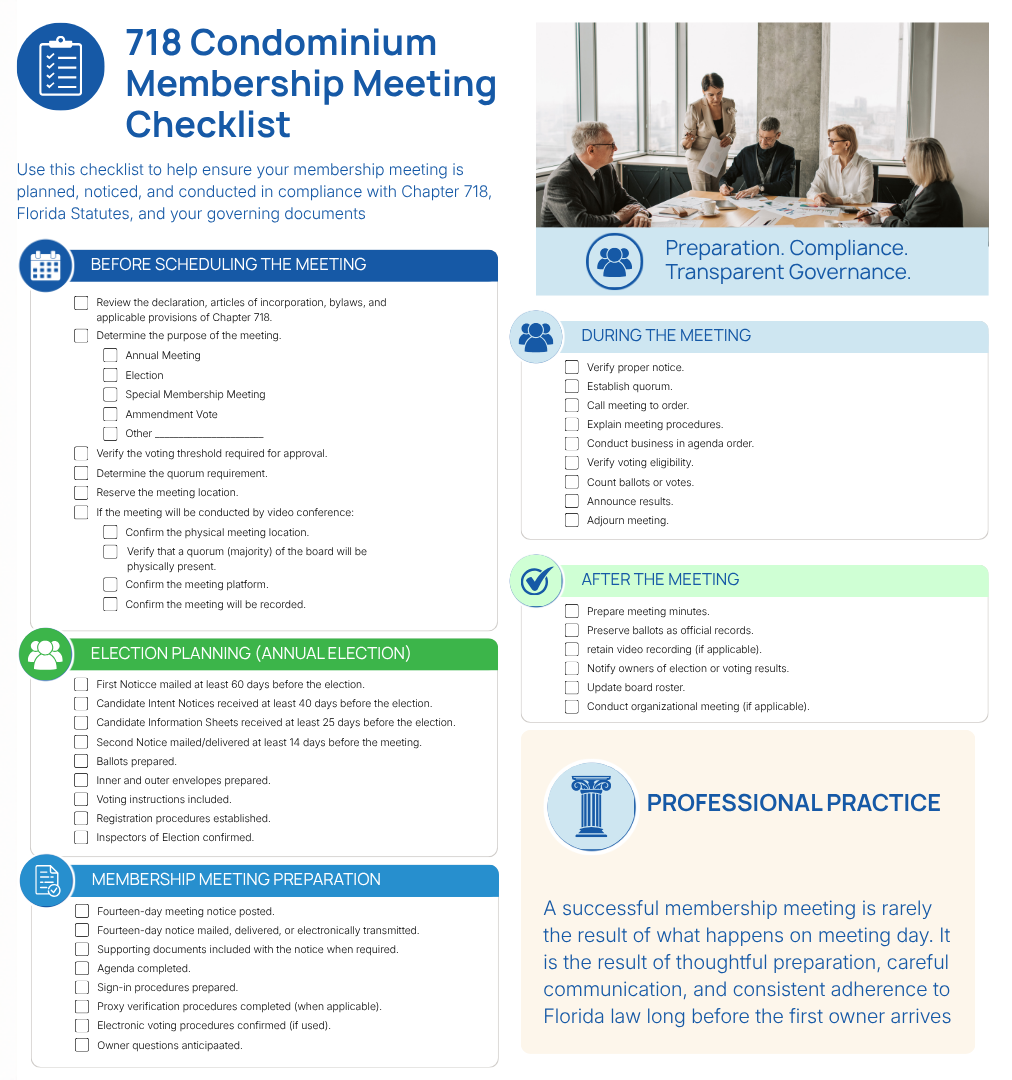
The election timeline generally includes:
- At least 60 days before the election – First Notice of Election.
- At least 40 days before the election – Candidate Notice Deadline.
- At least 35 days before the election – Candidate Information Sheets Due.
- At least 14 days before the meeting – Second Notice mailed or delivered, including the ballot package, candidate information sheets, inner and outer envelopes, and voting instructions.
Each deadline exists to ensure every owner has adequate notice, equal access to information, and a fair opportunity to participate.
Meeting Notice Requirements—Other Than the Election
The election has its own 60-day first-notice and second-notice process. For the annual membership meeting itself, however, the written notice must include an agenda; must be mailed, hand delivered, or electronically transmitted (if the owner has consented) to each unit owner at least fourteen (14) days before the meeting; and must be posted conspicuously on the condominium or association property for at least fourteen (14) continuous days before the meeting.
For a special or other nonannual unit owner meeting, the notice must also include an agenda and must be mailed, hand delivered, or electronically transmitted (if the owner has consented) to each unit owner and posted conspicuously on the property within the timeframe stated in the bylaws. If the bylaws are silent, the statutory default is at least fourteen (14) continuous days before the meeting. Electronic transmission may be used only for owners who have consented to receive notice electronically.
The notice should state the date, time, physical location, any video-conference access information, and the purpose of the meeting. Special meetings should identify the specific action to be considered. When another provision of Chapter 718 imposes a different notice package or procedure—such as a budget meeting, reserve vote, amendment vote, recall, material alteration, or electronic-voting authorization—the association must also satisfy that provision and its governing documents.
Website Posting Requirements
Effective January 1, 2026, a non-timeshare condominium association operating twenty-five (25) or more units must maintain the website or mobile-application postings required by Section 718.111(12)(g), Florida Statutes. The notice and agenda for any unit owner meeting must be posted no later than fourteen (14) days before the meeting, in plain view on the front page or on a conspicuously linked subpage labeled “Notices.”
Any document that will be considered and voted on by the owners, and any document listed on the agenda, must be posted at least seven (7) days before the meeting.
The association must also post copies of affidavits required by Chapter 718, subject to required redaction of protected information. If the meeting is conducted by video conference, the recording is an official record; for an association subject to the statutory website requirement, the recording or a hyperlink to it must remain posted for the preceding twelve (12) months.
Website posting supplements the required delivery and physical posting of the meeting notice; it does not replace those methods. The meeting file should therefore show each compliance step separately: owner delivery, physical posting, website posting, supporting: document posting, and the required affidavit or certificate of mailing.
Affidavit and Proof-of-Mailing Requirements
An officer of the association, the community association manager, or another person who provides the meeting notice must complete an affidavit—or obtain a United States Postal Service certificate of mailing—affirming that the notice was mailed or hand delivered in accordance with Section 718.112(2)(d), Florida Statutes. The proof should identify the meeting, the date and method of notice, and the person who provided it, and it must be placed in the association's official records.
Meeting Agenda Requirements
Every annual, special, or other unit owner meeting notice must include an agenda. The agenda should identify each item of business with enough specificity for an owner to understand what will be presented and what action or vote may be requested. If a vote will occur, the agenda and accompanying materials should state the proposal, identify the required voting threshold, and include the proper proxy, ballot, amendment text, budget, or other document required for informed voting.
The agenda is more than a meeting outline. Chapter 718 gives owners the right to participate with reference to all designated agenda items, subject to reasonable rules governing the frequency, duration, and manner of participation.
For that reason, the chair should follow the published agenda and should not ask the membership to take binding action on a material matter that was not fairly disclosed in the notice and agenda. Questions about whether an item may be added or acted upon should be evaluated under Chapter 718, the bylaws, and the specific voting requirement involved.
Membership Votes Beyond Director Elections
While the annual election often receives the greatest attention, condominium owners vote on many matters other than the election of directors. Depending upon the governing documents and the Condominium Act, owners may be asked to approve amendments to the declaration, articles of incorporation, or bylaws; authorize material alterations or substantial additions to the common elements; waive or reduce reserves; approve certain financial matters; or consider other issues specifically reserved to the membership.
Unlike director elections, these votes generally do not use the statutory two-envelope election ballot process. Instead, they are conducted through the voting procedures established by Chapter 718 and the association's governing documents.
For most membership business, the association must establish a quorum of the membership, as defined by the bylaws, before conducting business. Owners attending in person together with owners represented by valid proxies are counted toward the quorum.
Without a quorum, the membership generally cannot approve actions requiring owner approval.
Understanding Proxies
One of the most common areas of confusion involves proxies. Unlike director elections, proxies generally may be used for other membership votes, unless prohibited by Chapter 718 or the governing documents.
Florida law recognizes two primary types of proxies:
General Proxy – Authorizes another person to attend the meeting, establish quorum, and vote on matters that may properly come before the membership, except where the law requires a limited proxy or prohibits proxy voting.
Limited Proxy – Directs the proxy holder exactly how the vote must be cast on the specific issues identified in the proxy. Florida law requires limited proxies for certain matters, including votes to waive or reduce reserves and other actions identified by statute or administrative rule.
Providing the correct proxy form is essential. Using the wrong form can invalidate votes or create unnecessary challenges to the meeting.
Understanding the 20% Election Rule
One of the most misunderstood provisions of Chapter 718 is that the annual election of directors operates under different rules than the remainder of the annual membership meeting.
Most membership business requires the association to establish a quorum of the membership before business may be conducted.
Director elections are different. Chapter 718 provides that there is no quorum requirement for the election itself. Instead, the election is valid if at least twenty percent (20%) of the eligible voting interests cast ballots. Directors are elected by a plurality of the ballots cast.
This distinction often surprises board members. An association may conduct a perfectly valid election even though too few owners attend or are represented to establish a quorum for the remainder of the annual meeting. In that situation, the election results are valid, but other membership business requiring a quorum generally cannot be conducted.
Understanding this distinction helps boards avoid confusion on meeting day and allows managers to accurately explain why an election may proceed even when the remainder of the meeting cannot.
Owners' Participation and Meeting Rights
A membership meeting is the owners' meeting: it is the occasion when the membership receives information, considers matters reserved to the owners, and exercises its voting authority.
Section 718.112(2)(d)8., Florida Statutes, expressly gives unit owners the right to participate with reference to every designated agenda item. The chair should therefore provide a meaningful opportunity for owner comments or questions before the membership votes or concludes discussion on each item. The association may adopt reasonable rules governing the frequency, duration, and manner of participation, but those rules should promote an orderly meeting rather than eliminate the right itself.
General Owner Discussion
Because membership meetings belong to the owners in a governance sense, a well-planned annual meeting should ordinarily include a clearly identified owner forum or general discussion period. This gives owners an opportunity to raise community concerns that are not otherwise listed on the agenda and allows the board to hear issues that may require later attention.
Chapter 718, however, expressly guarantees participation on designated agenda items; it does not independently guarantee unlimited discussion of subjects that are not on the agenda. The bylaws and any reasonable meeting rules should therefore be reviewed. An owner forum should be used for listening, questions, and identifying future business—not for taking binding action on a material matter that was not properly noticed.
Why Boards Should Educate Owners About Their Rights
Boards benefit when owners understand how and when to participate. A short pre-meeting explanation of speaking procedures, voting methods, proxy limitations, recording rights, and the purpose of an owner forum reduces confusion, prevents procedural disputes, and makes the meeting easier to conduct. Education also helps owners distinguish between an opportunity to be heard and the authority to take formal action, which must remain tied to proper notice, quorum, voting thresholds, and the governing documents. When boards explain these rights before conflict arises, they demonstrate respect for the membership, encourage informed participation, and strengthen confidence that the association's decisions are fair, transparent, and legitimate.
Meeting Minute Requirements
The association must prepare and retain minutes of all unit owner meetings as part of its official records. The minutes should provide a clear, accurate record of what occurred, including the meeting date, time, and location; whether the meeting was held in person or by video conference; the person presiding; confirmation that notice was provided; establishment of quorum; approval of prior minutes when applicable; the exact wording or substance of motions; the name of the mover and seconder when recorded under the association's procedure; the vote or outcome on each matter; election results; points of order or rulings that materially affected the proceeding; and the time of adjournment.
Minutes are a record of actions taken, not a transcript of every comment. They should be objective, concise, and free of editorial observations. Draft minutes should be clearly labeled until approved in the manner required by the bylaws or the association's established procedure.
The statute's separate website list specifically requires approved board-meeting minutes but does not independently require unit owner meeting minutes to be posted unless another applicable requirement or the governing documents do so.

2025 Changes Reshaped Membership Meetings
Annual Meetings Conducted by Video Conference
Annual and other unit owner meetings may be conducted through video conference, allowing owners to participate remotely while preserving the legal validity of the meeting.
Remote participation does not eliminate the requirement for a physical meeting location. Owners must continue to have the opportunity to attend the meeting in person at the designated location.
When a membership meeting is conducted by video conference, a quorum (majority) of the board of administration must be physically present at the designated meeting location.
The annual meeting cannot simply consist of directors attending individually from remote locations. This requirement preserves accountability by ensuring directors remain available to the membership.
Meetings Conducted by Video Conference Must Be Recorded
One of the most significant transparency provisions added by House Bill 913 requires that membership meetings conducted by video conference be recorded.
The recording becomes an official record of the association and supplements the written minutes by preserving an accurate record of the proceedings.
Expanded Electronic Voting Options
Florida law has continued to expand electronic voting opportunities. Associations may continue to use approved third-party online voting platforms that satisfy the authentication, ballot security, secrecy, and record retention requirements established by Section 718.128.
If an association has not adopted an approved online voting platform, it must designate an email address to receive electronically transmitted ballots as authorized by the 2025 amendments. Owners choosing this method must comply with the statutory procedures, including acknowledging that submitting a ballot by email waives ballot secrecy.
DBPR – Department of Business and Professional Regulation
Florida Homeowners (720) Statutes: Understanding Membership Meetings
By Doug Jenkins
Membership meetings are among the most important events in the life of a homeowners' association. They are the formal occasions when the members of the association exercise the rights reserved to them under Florida law and the association's governing documents. Directors are elected, governing documents may be amended, matters requiring member approval are considered, and the board reports to the community it serves.
Although the board of directors is responsible for managing the affairs of the association throughout the year, certain decisions remain with the membership. Florida's Homeowners' Association Act establishes the legal framework for these meetings, while the association's declaration, articles of incorporation, and bylaws provide many of the specific procedures governing how membership meetings are conducted.
These meetings are more than annual business sessions. They represent one of the most important opportunities for owners to participate in the governance of their community. Wellplanned membership meetings encourage transparency, strengthen confidence in the board, and ensure that every owner has a fair opportunity to participate in decisions affecting the association.
Membership meetings occur whenever the owners are called upon to exercise authority reserved to the membership.
Common membership meetings include:
- Annual Membership Meetings for the election of directors and other annual business.
- Special Membership Meetings called to consider a specific matter requiring member approval.
- Meetings to Amend Governing Documents, including the declaration, articles of incorporation, or bylaws.
- Meetings to Consider Financial Matters requiring owner approval under the governing documents.
- Recall Meetings and Other Special Proceedings authorized by Florida law.
Each meeting should begin with a simple question:
What authority has been reserved to the membership?
The answer determines the applicable notice requirements, voting procedures, quorum, proxy requirements, and approval threshold.
Notice Is More Than a Legal Requirement
One of the primary purposes of statutory notice is to provide every owner with a meaningful opportunity to participate.
Unless governing documents indicate differently, actual notice of a membership meeting must be mailed, delivered, or electronically transmitted (if the owner has consented) to each parcel owner and member at least fourteen (14) days before the meeting.
Physical posting is not a universal statutory requirement for every Chapter 720 membership meeting, but it may be required by the governing documents. Website-posting requirements apply to associations with 100 or more parcels and must correspond to the timing for physical notices.
The notice should clearly identify:
- The date, time, and location of the meeting.
- The purpose of the meeting.
- The business to be conducted.
- Any documents owners should review before voting.
When amendments, special assessments, or other significant matters will be considered, supporting documents should accompany the notice.
A clear, informative notice is often the first step toward a successful meeting.
Membership Meeting Agenda Requirements
Chapter 720 does not prescribe one universal agenda format for every homeowners' association membership meeting; the association must also follow its articles of incorporation and bylaws. Even so, the agenda is a central part of fair notice and owner participation. It should identify each matter to be presented, discussed, or voted upon with enough specificity for owners to understand the business of the meeting. If a vote will occur, the agenda and accompanying materials should identify the proposal, the applicable approval threshold, and the form of voting to be used, and should include any amendment text, proxy, ballot, budget information, or other document required by law or the governing documents.
For a special membership meeting, Section 720.306(4), Florida Statutes, requires the notice to describe the purpose or purposes for which the meeting is called, and Section 720.306(3) limits the business conducted at that meeting to the purposes stated in the notice.
The agenda should track those stated purposes closely. The association should not ask the membership to take binding action on a material matter that was not fairly disclosed.
An association with 100 or more parcels must also post the notice and agenda for a scheduled membership meeting on its website or mobile application at least fourteen (14) days before the meeting. Any document that will be considered and voted on by the members, and any document listed on the agenda, must be posted at least seven (7) days before the meeting.
Members' Participation Rights
A membership meeting is the members' meeting. It is the occasion when owners receive information, discuss community concerns, and exercise the authority reserved to the membership. Section 720.306(6), Florida Statutes, gives members and parcel owners the right to attend every membership meeting and to speak with reference to every item opened for discussion or included on the agenda.
Regardless of contrary language in the governing documents or association rules, each member and parcel owner must be allowed to speak for at least three (3) minutes on each item. The association may adopt written reasonable rules governing the frequency, duration beyond the statutory minimum, and manner of statements, but those rules must remain consistent with the right itself.
General Owner Discussion
The agenda should include a clearly identified Member and Owner Forum or General Community Discussion item. A general forum allows owners to raise concerns, identify emerging issues, and suggest matters for future board or membership consideration. It should be conducted respectfully and under reasonable written rules, but it should not be reduced to an unimportant opportunity in which owners cannot meaningfully address the community's business.
The forum does not eliminate the requirements for notice and proper authority. Owners may discuss an issue and request future consideration, but the membership should not take binding action on a material matter that was not properly noticed or that is not within the membership's authority. Matters raised during general discussion can be referred to the board, placed on a future agenda, or addressed through an applicable petition or special-meeting process.
Why Boards Should Educate Owners About Their Rights
Boards benefit when owners understand how and when to participate. A short explanation before the meeting of speaking procedures, the three-minute minimum, the purpose of the owner forum, voting and proxy rules, recording rights, and the petition and special-meeting processes reduces confusion and prevents avoidable procedural disputes. Education also helps owners distinguish between the right to be heard and the authority to take formal action, which remains subject to notice, quorum, voting thresholds, and the governing documents. When boards explain these rights before conflict arises, they demonstrate respect for the membership, encourage informed participation, and strengthen confidence that the association's decisions are fair, transparent, and legitimate.
Elections Begin with Good Planning
Unlike many other membership actions, the election of directors is often governed primarily by the association's bylaws. For that reason, the board should review its governing documents well in advance of every annual meeting to determine the nomination process, voting procedures, candidate qualifications, quorum requirements, and the number of directors to be elected.
If the governing documents establish specific election procedures, those procedures should be followed unless they conflict with Florida law.
When the governing documents provide little or no direction, Chapter 720 supplies the default process.
Unless otherwise provided in the bylaws:
- Directors are elected at the annual membership meeting.
- Nominations may be made from the floor during the meeting.
- Voting occurs at the meeting after nominations have been closed.
- Each member casts the number of votes authorized by the governing documents.
- The candidates receiving the highest number of votes are elected to fill the available positions.
Because nominations may be accepted during the meeting when the bylaws do not establish an advance nomination process, voting generally cannot occur before the meeting. This ensures that owners have the opportunity to vote for every eligible candidate who is properly nominated.
Boards should communicate the election procedures well before the annual meeting so owners understand how candidates may be nominated, when voting will occur, and how the results will be determined.
Membership Votes Beyond Director Elections
Many membership meetings involve voting on issues other than electing directors.
Owners may be asked to approve amendments to the governing documents, authorize financial matters requiring owner approval, approve mergers or other corporate actions, or vote on matters specifically reserved to the membership.
Each proposal should be presented clearly so that owners understand exactly what they are being asked to approve.
Understanding Proxies
Proxies are one of the most important tools available for membership meetings.
Many associations rely upon proxies to establish quorum and allow owners who cannot attend the meeting to participate in association business.
Florida law recognizes two primary types of proxies.
General Proxy
A general proxy authorizes another individual to attend the meeting, establish quorum, and vote on matters that properly come before the membership.
Limited Proxy
A limited proxy directs the proxy holder exactly how to vote on one or more identified issues.
Whenever a limited proxy is required by Florida law or the governing documents, the association should provide the appropriate proxy form together with the meeting notice.
Preparing accurate proxy forms is one of the simplest ways to avoid disputes and ensure every owner's voting intentions are honored.
Quorum Makes Membership Action Possible
Before conducting membership business, the association must establish that a quorum of the membership is present in person or by proxy as provided in the governing documents.
Without a quorum, the membership generally cannot conduct business requiring owner approval.
Because quorum requirements vary among associations, every board should review its governing documents well before scheduling a membership meeting. If the governing documents are silent, a simple majority represents a quorum per statute.
Understanding the quorum requirement early allows the board and management to communicate with owners, encourage participation, and avoid postponing important association business.
Transparency Builds Confidence
Membership meetings are about more than voting.
They provide owners with an opportunity to become informed, participate in the governance of their community, and observe the association conducting its business openly and professionally.
Boards that communicate frequently, provide complete information before meetings, encourage participation, and conduct meetings in an organized and respectful manner build confidence throughout the community.
Owners may not always agree with the outcome of every vote. They are far more likely, however, to accept the outcome when they believe the process was fair, transparent, and conducted in accordance with Florida law and the association's governing documents.
Professional Practice
Successful membership meetings begin long before the first owner arrives.
Boards should establish an annual meeting calendar, review their governing documents well in advance, prepare accurate notices and proxy forms, clearly explain the business to be conducted, and encourage owner participation throughout the planning process.
Good governance is built on preparation. When a meeting is well organized, owners spend less time questioning the process and more time participating in the future of their community.
DBPR – Department of Business and Professional Regulation

Seven Membership Meeting Pitfalls to Avoid
Even the most experienced boards occasionally encounter challenges when planning or conducting membership meetings. Here are seven common pitfalls to avoid.
1. Waiting Too Long to Begin Planning
Many membership meeting problems begin months before the meeting is ever called to order. Waiting until notice deadlines are approaching often results in rushed decisions, incomplete meeting packets, scheduling conflicts, and avoidable mistakes. Professional Practice: Establish an annual governance calendar and begin planning membership meetings well before statutory notice deadlines.
2. Missing Notice Requirements
Meeting notices are among the most common sources of procedural errors. Missing a posting deadline, failing to properly deliver notice, omitting required documents, or providing an incomplete agenda can delay business and undermine owner confidence in the process.
Remember: A meeting notice is more than an announcement—it protects every owner's right to participate.
3. Confusing Board Business with Membership Business
Not every decision belongs to the board, and not every meeting belongs to the membership. Before scheduling a meeting, determine whether the proposed action is one the board may approve or whether it has been reserved to the membership by Florida law or the governing documents.
Ask First: Who has the legal authority to make this decision?
4. Using the Wrong Voting Method
Election ballots, general proxies, limited proxies, electronic voting, and voting at the meeting each serve different purposes.
Selecting the wrong voting method—or providing the wrong forms—can create unnecessary confusion and may affect the validity of the vote. Professional Practice: Match the voting procedure to the specific action being considered and verify that it complies with both Florida law and your governing documents.
5. Overlooking the Governing Documents
Florida law establishes the framework for membership meetings, but many important procedural details including quorum requirements, voting procedures, nomination processes, and approval thresholds—are found within the association's declaration, articles of incorporation, and bylaws.
Best Practice: Review the governing documents before planning every membership meeting—not after questions arise.
6. Misunderstanding Quorum
Many boards focus on how many votes are needed to approve a motion without first determining whether enough members are present or represented by proxy to legally conduct business.
Quorum should be established early in the meeting and clearly reflected in the minutes.
Professional Reminder: Without quorum, the membership generally cannot conduct business requiring owner approval.
7. Treating Minutes as a Transcript
Membership meeting minutes should record the official actions of the membership—not every discussion, opinion, or debate.
Effective minutes document:
- The date, time, and location of the meeting.
- Confirmation that proper notice was given.
- Whether quorum was established.
- Motions made and voting results.
- Actions approved by the membership.
- Time of adjournment.
Clear, concise minutes become part of the association's permanent official records and provide an accurate history of the decisions made by the membership.
The Common Thread
Boards that begin planning early, understand both Florida law and their governing documents, and communicate clearly with owners rarely experience significant membership meeting problems. Good governance is seldom the result of good fortune—it is almost always the result of thoughtful preparation.
DBPR Begins Rulemaking to for Key Legislative Changes
Key legislative changes affecting Florida community associations in 2024 and 2025 were substantial. These proposed administrative rules represent the next step, the DBPR translating statutory requirements into practical administrative procedures. While many of the proposals simply implement existing legislation, others provide important clarification that will influence how associations, managers, and education providers carry out their responsibilities. We will continue to monitor the rulemaking process and report on significant developments as these rules move toward final adoption.
Proposed Rule 61B-23.001 – Condominium Board and Membership Meetings
This proposal substantially revises the administrative rule governing condominium board, committee, and membership meetings. It incorporates many of the meeting requirements enacted through recent legislation, including expanded definitions of meetings, standards for meetings conducted by video conference, recording requirements for electronically conducted meetings, inspection of meeting materials before meetings, enhanced notice requirements, detailed agenda requirements, owner participation rights, and procedures governing audio and video recording by owners. The proposal also provides additional guidance regarding rescheduled meetings and meeting conduct intended to improve transparency and consistency throughout the state.
Proposed Rule 61B-21 – Enforcement Guidelines and Penalties
The Department has also proposed a comprehensive update to its enforcement rules governing condominium associations. The proposal modernizes the Department's enforcement process by expanding definitions, establishing formal citation procedures, clarifying what constitutes minor violations, identifying aggravating and mitigating factors used when determining penalties, and updating the Department's disciplinary guidelines. Collectively, these revisions reflect the Legislature's expansion of the Division's enforcement authority and provide greater transparency regarding how investigations and enforcement actions will be handled.
Proposed Rule 61B-19.001 – Condominium Board Education Providers
Following the Legislature's creation of standardized condominium board education requirements, the Department has proposed new administrative rules governing providers of Board Member Certification and Continuing Education programs. The proposal establishes instructor qualification standards, provider approval and renewal procedures, acceptable course delivery methods, participant verification requirements, record retention obligations, and standardized certificates of completion. The rules are intended to ensure consistent delivery and administration of board education statewide.
Proposed Rule 61B-19.004 – Homeowners' Association Board Education
The Department has also proposed a new rule establishing the framework for homeowners' association board education under Section 720.3033, Florida Statutes. Similar to the condominium proposal, the rule establishes provider qualifications, course approval procedures, delivery methods, participant verification standards, record retention requirements, and continuing education requirements for HOA directors. It also creates an approval pathway for existing Community Association Manager continuing education courses to satisfy certain HOA continuing education requirements when appropriate.